

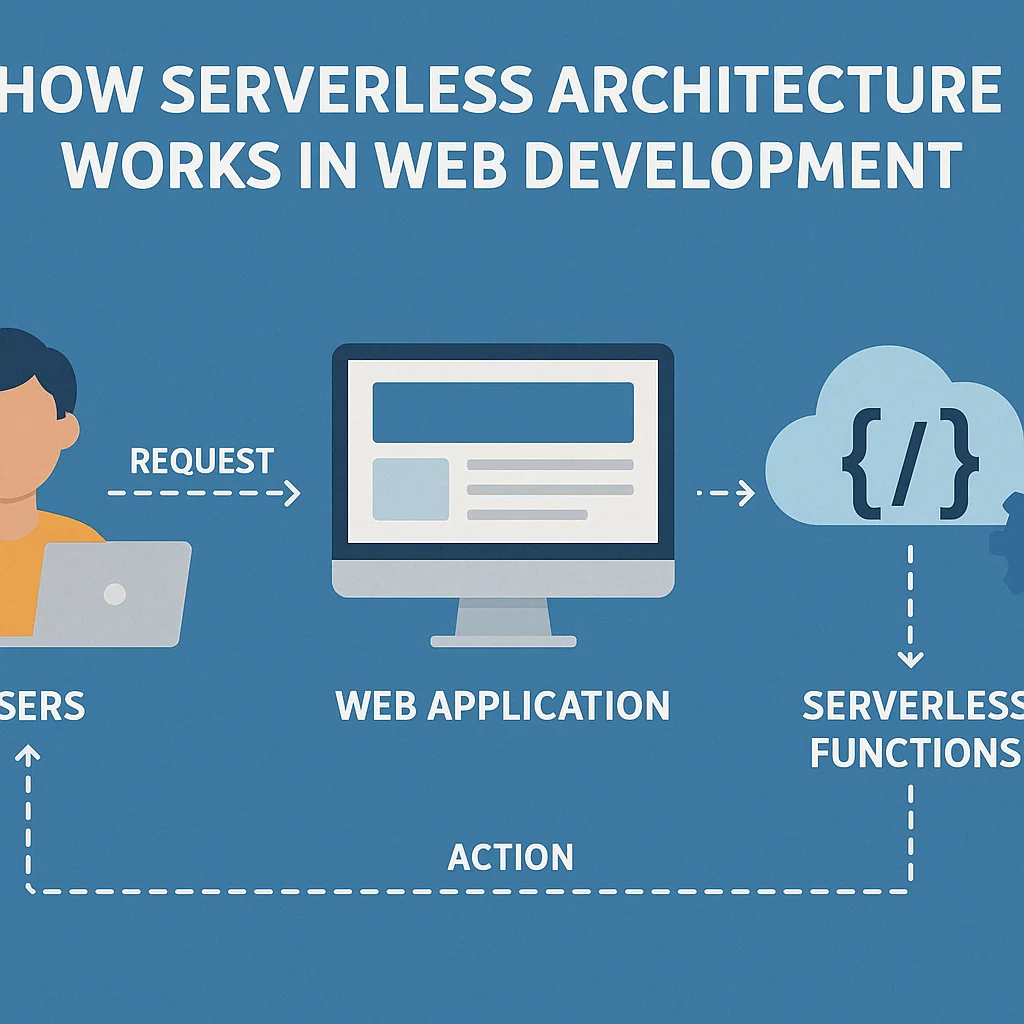
In the ever-evolving world of web development, businesses and developers are constantly searching for innovative solutions that deliver scalability, performance, and cost efficiency. One such approach that has gained massive popularity in recent years is serverless architecture. Despite the name, serverless does not mean “no servers.” Instead, it means developers no longer need to manage servers directly, as cloud providers handle all the underlying infrastructure.
What is Serverless Architecture?
Serverless architecture is a cloud-native development model where application logic is executed in stateless compute containers, which are fully managed by a third-party provider like AWS, Microsoft Azure, or Google Cloud Platform.
Instead of provisioning, scaling, and maintaining servers, developers write code as functions and deploy them directly to the cloud. These functions execute only when triggered by specific events, such as an API call, file upload, or database query.
In simple words:
- You write code.
- Upload it to the cloud.
- The cloud runs it only when required.
- You pay only for the execution time, not for idle servers.
How Does Serverless Architecture Work?
Serverless architecture relies heavily on the Function as a Service (FaaS) model. Here’s a step-by-step explanation of how it works:
1. Event-Driven Execution
Serverless applications are triggered by events. These events could be:
- An HTTP request hitting an endpoint.
- A file uploaded to cloud storage.
- A scheduled cron job.
- A change in a database table.
2. Functions as the Core Unit
Developers break down their code into small, modular pieces called functions. Each function performs a specific task, such as processing a payment or sending an email notification.
12. Summary Table: Roles & Pay Scale in Serverless Web Development
| Role | Experience | Education | Estimated Salary (₹) |
|---|---|---|---|
| Cloud Support Engineer | 0–2 yrs | Graduate / Cloud Basics | 3–6 lakh/year |
| Backend Developer (Serverless APIs) | 1–3 yrs | Graduate (CS/IT preferred) | 5–10 lakh/year |
| DevOps Engineer (Serverless) | 2–4 yrs | Graduate + AWS/Azure cert | 8–14 lakh/year |
| Cloud Architect (Serverless Focus) | 5+ yrs | Graduate + Cloud Certs | 15–25 lakh/year |
| Full-Stack Developer (Serverless) | 2–5 yrs | Graduate / Bootcamp | 6–12 lakh/year |
| Data Engineer (Serverless ETL) | 3–6 yrs | Graduate (CS/IT/Stats) | 10–18 lakh/year |
| ML Engineer (Serverless Deployment) | 4–7 yrs | Graduate / PG in AI/ML | 12–20 lakh/year |
| Solutions Consultant (Serverless) | 6–10 yrs | Graduate + MBA (adv.) | 18–30 lakh/year |
3. Cloud Provider Management
The cloud provider (AWS Lambda, Azure Functions, Google Cloud Functions, etc.) automatically:
- Allocates resources.
- Runs the code in containers.
- Scales up or down based on demand.
- Handles monitoring, security, and logging.
4. Automatic Scaling
Unlike traditional servers, serverless functions scale horizontally in milliseconds. If 1,000 users send requests simultaneously, the provider runs multiple instances of your function without you lifting a finger.
5. Pay-as-You-Go Pricing
Billing is based only on:
- The number of function executions.
- The duration of execution (measured in milliseconds).
- The memory allocated to the function.
This model ensures businesses don’t pay for unused resources.
Components of Serverless Architecture
Serverless is not just about FaaS; it includes multiple managed services:
- Function-as-a-Service (FaaS): Core execution engine (AWS Lambda, Azure Functions, Google Cloud Functions).
- Backend-as-a-Service (BaaS): Managed services like databases, authentication, and storage (Firebase, Auth0, DynamoDB).
- API Gateway: Manages HTTP requests and routes them to the right serverless functions.
- Database Services: Serverless databases like Firebase Firestore or AWS DynamoDB automatically scale based on usage.
- Monitoring Tools: CloudWatch, Stackdriver, or Application Insights track performance and errors.
Advantages of Serverless Architecture in Web Development
1. No Server Management
Developers focus on building features, not handling servers, patching, or scaling.
2. Cost Efficiency
You pay only for what you use—no charges for idle infrastructure.
3. Scalability
Serverless functions scale instantly to meet demand, making them ideal for applications with unpredictable workloads.
4. Faster Development
Serverless reduces time-to-market by eliminating infrastructure concerns. Developers can quickly build, test, and deploy functions.
5. Global Reach
Cloud providers run your functions across multiple regions, ensuring low latency for users worldwide.
Challenges of Serverless Architecture
While serverless has huge benefits, it comes with challenges:
- Cold Start Latency: Functions that haven’t been invoked recently may take extra time to start.
- Vendor Lock-in: Applications may become dependent on one cloud provider’s ecosystem.
- Limited Execution Time: Most providers restrict how long a function can run (e.g., AWS Lambda max is 15 minutes).
- Complex Debugging: Debugging distributed serverless applications can be harder than traditional systems.
- State Management: Since functions are stateless, managing user sessions and persistent data requires external solutions.
Use Cases of Serverless in Web Development
Serverless is particularly useful in the following scenarios:
- Building REST APIs
Serverless APIs are cost-efficient and scalable. Functions handle each request and interact with databases as needed. - Real-Time File Processing
For apps that process images, videos, or documents, serverless triggers can automate tasks like resizing, watermarking, or virus scanning. - Chatbots and Real-Time Applications
Serverless functions respond quickly to user queries in chatbots or messaging platforms. - IoT Applications
Devices sending data can trigger serverless functions for real-time analytics. - Scheduled Tasks
Functions can replace cron jobs to run scheduled maintenance tasks. - Authentication and Authorization
Integration with managed services like Firebase Authentication or Cognito makes it easier to implement login systems.
Serverless Architecture vs Traditional Architecture
| Feature | Traditional Servers | Serverless Architecture |
|---|---|---|
| Server Management | Required (manual setup, scaling, updates) | Not required (cloud handles it) |
| Cost Model | Pay for uptime and reserved resources | Pay per execution |
| Scalability | Limited, needs configuration | Automatic and unlimited |
| Deployment | Large, monolithic apps | Small, modular functions |
| Performance | Consistent | May face cold starts |
Popular Serverless Platforms
- AWS Lambda – The pioneer of serverless computing.
- Microsoft Azure Functions – Deep integration with Azure services.
- Google Cloud Functions – Great for Google ecosystem developers.
- IBM Cloud Functions – Based on Apache OpenWhisk.
- Netlify Functions / Vercel Serverless Functions – Popular for JAMstack applications.
Best Practices for Using Serverless Architecture
- Keep Functions Small and Focused
Each function should do one task well, making it easier to maintain and scale. - Optimize Cold Starts
Use warm-up plugins or provisioned concurrency for critical functions. - Monitor Usage and Costs
Track execution time, memory usage, and errors using built-in monitoring tools. - Secure Your Functions
Use authentication, authorization, and API keys to protect endpoints. - Design for Statelessness
Store data in databases or cache systems rather than inside functions.
Future of Serverless Architecture in Web Development
Serverless is not just a trend—it’s becoming the future standard for modern applications. With more providers improving cold-start times, offering better developer tools, and expanding global infrastructure, serverless will power everything from enterprise SaaS platforms to AI-driven web apps.
As businesses move towards microservices and cloud-native applications, serverless fits perfectly into this transformation by offering flexibility, reduced costs, and global scalability.
Conclusion
Serverless architecture has revolutionized web development by eliminating server management, enabling automatic scaling, and reducing costs. It empowers developers to focus on what truly matters—building innovative applications rather than worrying about infrastructure.
Whether you’re a startup building a new app, or an enterprise scaling a global product, serverless can provide the flexibility and efficiency your project needs.
